

Because We Live Here

This is the extended version of the article I wrote for Michigan Enjoyer here.
On a brisk night where many Michiganders just left the ski slopes or perhaps their kid’s High School Basketball game, a mass of parents and children streamed into a municipal building wearing baseball caps, marching in grim determination to the town hall and defend their beloved little league. This icy, quiet evening in mid-January would seem to be the last place where baseball is in the forefront of a small Midwest town’s agenda, but a seemingly innocuous proposal for community beautification brought the area to standing room only as concerned residents swarmed to defend a shining beacon of their quaint town.
Caps and uniforms showcasing the “South Farmington Baseball” logo spanned the room as worried residents voiced their concerns over a proposal to remove a baseball field in one of the parks. The Farmington town council, looking to be progressive and forward-looking, had unleashed a hornet’s nest. It wasn’t an isolated incident either, as neighboring Farmington Hills had an even more aggressive proposal to remove four baseball fields. The already strained recreational little league felt backed into a corner, the two councils seeming to work in coordination to stifle their miraculous rejuvenation. To the council members’ defense, they had no ill will towards youth recreational sports. Their considerations were toward an increasing demographic that exploded in the last five years, South Asians. The proposal in both cities was to convert those large fields into Cricket pitches to accommodate these newcomers.
A dozen Little League supporters, coaches, and players relayed their concerns in the comments section, spoken in the most diplomatic way possible, ignoring the demographic elephant in the room. Most everyone spent their adult lives within the city or surrounding towns, many coming from multiple generations back. “Who here is in support of this proposal?” one of the coaches asked. No one raised their hands. They brought up statistics of growth, emotion laden pleas, and moderate calls for compromise. A few made careful comments about the council’s responsibility for long-time residents and their children, skirting the uncomfortable underlying issue. It wasn’t until the online comments came up and the assistant city manager relayed an anonymous poster’s short, caustic comment “Why are we destroying baseball fields? Let the Indians play cricket somewhere else.” that the quiet part was spoken out loud.
Baseball is a proud American institution. While it has its roots in older European sports, its culture, fanfare, and spectacle grew along with the country, forming something wholly unique. Its mythology goes back over a century, with children today still knowing the legend of Babe Ruth, recognizing old timey team pictures of times long past along with the music and festivities of the stadium experience. On the local level, Little Leagues uniforms emblazoned with the logos of downtown businesses has brought a sense of community and cohesion few other institutions can match. The lessons of teamwork, cohesion, and perseverance have made every parent want to transmit the game to the next generation. It’s ascended beyond being a mere sport and is now a facet of national character.
Modern youth baseball has seen a decline over the last couple of decades, coinciding with the decline of communities that could once maintain them. Worse, the rise of travel sports has sucked out local talent, along with young child’s sense of place. Local travel teams often cost several thousand dollars in addition to the time commitment of constant road trips. Time-strapped dads volunteering their time for a local league where you got a mixed bag of talent together and had fun has been replaced with a professional coaches in a darwinian struggle for travel teams to get the best of the best. Year-round practice is common to keep up with an ever-competitive talent pool. South Farmington’s recreational Little League saw a similar downward trajectory as fewer kids roamed the streets and parents changed priorities to chase elite sports or specialized academics.
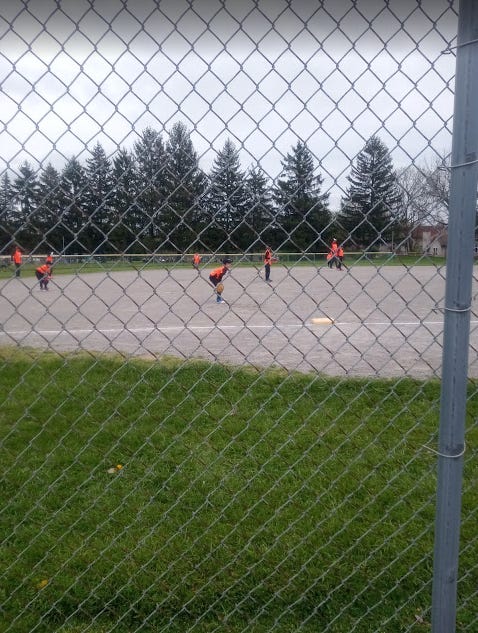
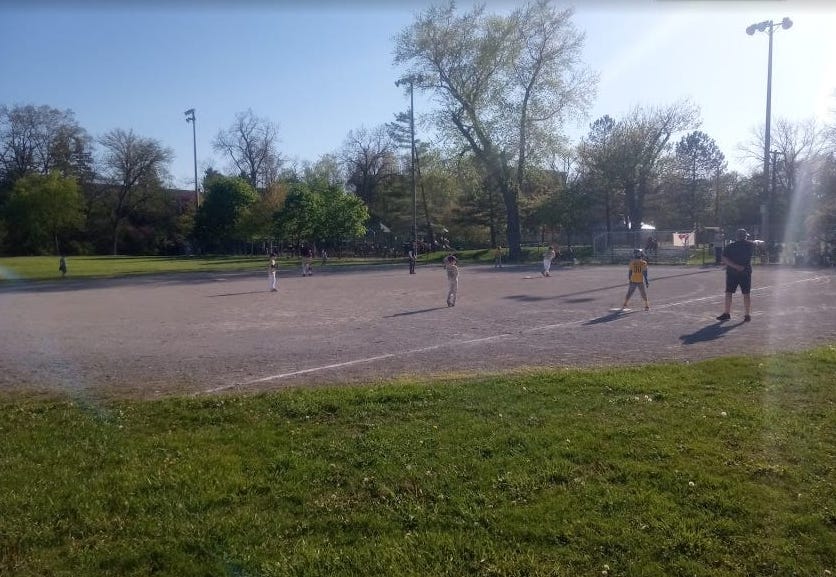
In the last five years though, there’s been a miraculous revival. Through community involvement, advocacy, and thousands of hours of unpaid work, the local Little League has increased doubled from 615 to over 1200 in the last five years. The seasons begin with a parade of young athletes marching through downtown and during the season, players gleefully go for ice cream or burgers at one of their many sponsors. The nostalgic Americana of an earlier era comes out in full force. The level of commitment from the parent to the players continues to grow, and the league has solidified itself as a core part of civic life. A victim of its own success, scheduling a field during both summer and fall season has become more difficult, with many games and practices needing lights to play as late as 10 o’clock at night. None of the growth is abating, and its continued growth without the infrastructure available may force the organization to have a lottery or tryouts.
In the last couple of years though, other communities have also used the space. While a Baseball field is not ideal for Cricket, East Asians are often on the fields, with coaches kicking them off for Little League practices. These newcomers, mostly young men, immigrated through the H1-B process, employed by car manufacturers and other tech firms in Detroit. The relationship has been amicable and there’s no trouble, but this might change. As their population increases, so will their demand for public spaces for their sports. The City Council plan didn’t come out of the blue. Demographic change is real, as well as the problem they were trying to solve.
Perhaps a reasonable compromise will be made. There were discussions of dual-use fields that can accommodate both. They would be rented by the Cricket athletes, though with preferred use by the Little League during peak hours, but otherwise will be allocated just like anything else. This sort of revision would likely be accepted by most parents, though with strong reservations. In its essence, the conflict points to an existential issue.
Baseball is part of the historic culture of the American people, one of the countless nodes of identity that form the nomos of a people. It was fostered through multiple generations living in the same area, saturated in the invisible norms and customs that make public life livable. While the conflict between Cricket and Baseball fields could find a workable compromise. there’s the understanding that South Asian culture is not Midwest culture. While Cricket is, of course, British in its origins, it is not part of the American fabric, and there’s nothing organic about its growth. Demographic change is transforming aspects of classic Americana taken for granted, creating tensions where none should exist.
This conflict is a microcosm of the social upheavals rapid demographic transformation has created. As the foreign-born population nationally has increased to 14 percent of the population, they have formed insular conclaves fundamentally different than the surrounding culture. Parents are stuck between sounding racist by voicing concerns for their progeny or accepting the demographic transformation they neither asked nor voted for. No one asked their city to be flooded with foreign workers, and the harsh truth is this conflict would not exist if the South Asians weren’t imported in. The ideal of integration isn’t happening, and there’s almost a reverse integration demanded, where historical residents have to change their public spaces to accommodate recent immigrants.
None of the newcomers are interested in maintaining these beloved American institutions. They have their own traditions. While there’s nothing wrong with Cricket, it is a foreign sport. No one’s father played Cricket. There are no great documentaries on American Cricket, and no Cricket player is a household name. It doesn’t have the resonance in the average American. Watching South Asian adult men playing this sport next to a baseball game consisting of mostly white and black kids gives a stark reminder of the culture clash taking place. Though both groups are polite and amicable, they are not integrating. The South Asian newcomers with kids are not putting their kids in Little League and are comfortable in their mini-society residing in but living outside the wider community. While some natively born Americans have taken up Cricket, it is small subset of its player base. It’s likely none of the newcomers will be interested in maintaining both Baseball and other parts of the current civic order.
Note that every party here is nonviolent and economically productive. The South Asians are, by the metrics of policy wonks, model immigrants. While the immigration debate has largely been steeped in migrants scamming social safety nets or being more violent than the general population, tensions go far beyond numbers that can be put into a spreadsheet. There’s no metric to analyze the value of Little League baseball, nor is there a way to crunch the data on the value of traditions spanning several generations. Such questions of identity boil down to the spiritual character of the community they want to bequeath to the next generation.
At best, many of the South Asian children will be inoculated into the echelons of the professional classes through going to the right colleges and getting the right job. Others will maintain the old forms in the new world. None of these create the high-trust small-town values Americana these Baseball families yearn for. Culture is the dads who maintain the city neglected fields so their kids can play. It’s a child walking into the ice cream shop with a dusty uniform for a victory sundae. It’s the extended family cheering from the bleachers and sharing in all the next generation’s pitfalls and triumphs. It’s the civic bond between the market and the people, the unspoken contract between the youth and the parents to maintain the same sort of community for their progeny, just as their parents did.
If Baseball culture is severed, so will the collective experience of great-grandfather, to grandfather, to father, to son, all of which have poignant memories of youthful days of dusting up their uniforms, bantering in the dugout, and making the big play in the sprawling green outfield.
The Farmington Battle is a small subset of the clash of values happening across the nation. While egghead worry about GDP and crime stats, parents are wondering what happened to Americana, and why they have to plead their case to maintain an American Institution against encroaching outsiders. Such conflicts will only grow, and it’s my hope my grandchildren get to experience the satisfying crack as they hit a ball far into the outfield, or slide onto home for the winning run, their pristine uniform caked in dust as their grandparents scream from the stands. It’s not an abstract spreadsheet field, but an actual place you can feel and touch right outside your backyard. “Because we Live Here” is not an irrational prejudice of a bygone age, but the only reality worth fighting for.
Thank you for reading Social Matter. If you liked this article, please share and subscribe. If you love Americana, please become a paid subscriber.
Several of our movie theaters in Denver area show exclusively hindi movies now. The H1-B population is insanely out of control with all the technology here. My issue is all the well paid jobs they take from citizens in addition to the cultural issues you mentioned. Excellent article.
Short term gain for long term pain.
Here in MN, if dems win again, there will be no limit of immigrants, all on the dole, to make a one party state, to keep the theft going on.