

Dilbert: A Postmortem
Scott Adams Gleefully Murdered His Own Creation

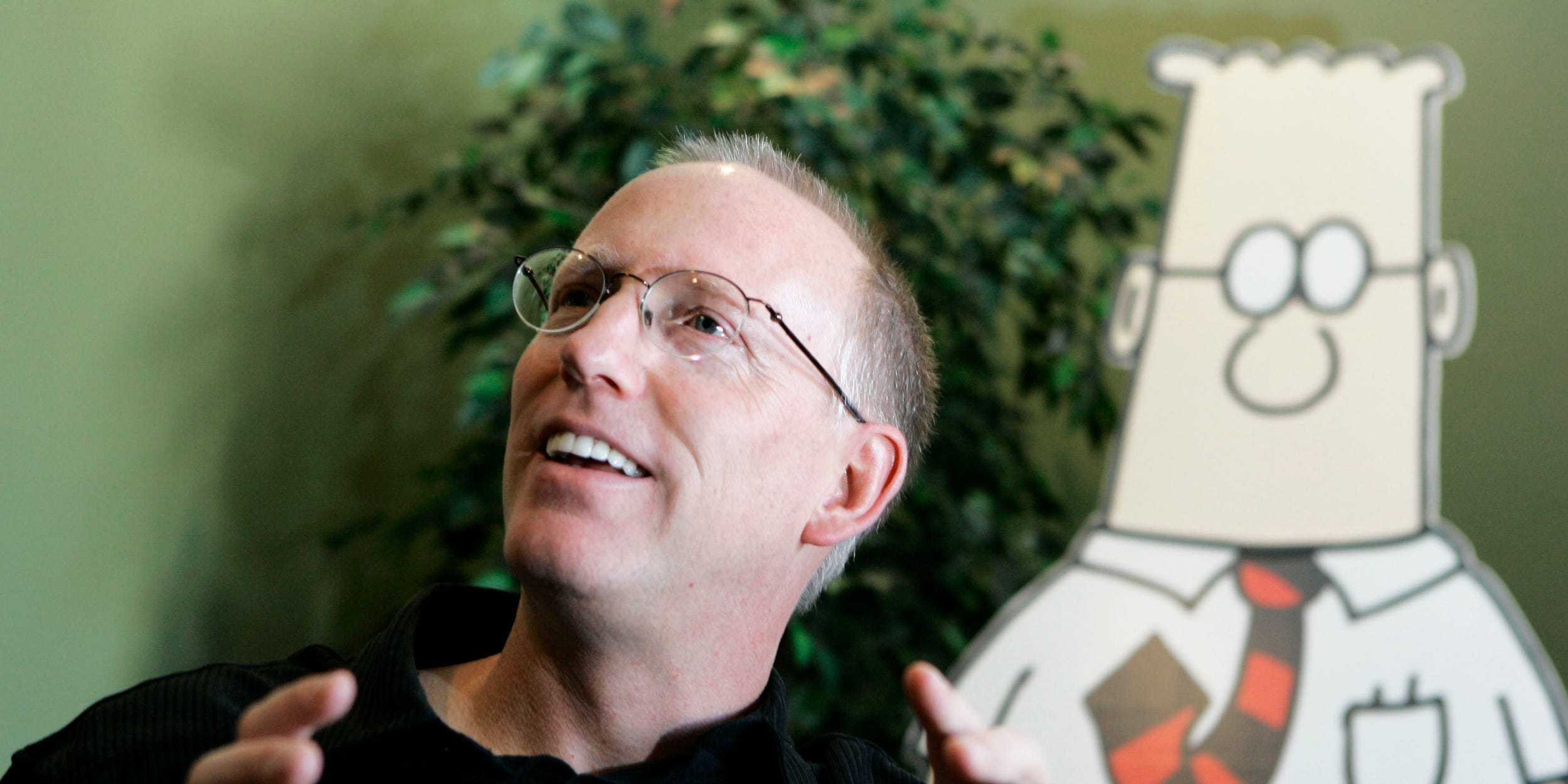
Scott Adams passed away on January 13, 2026 after a battle with cancer. His career trajectory was as strange as his famous newspaper comic. He started out as your basic office drone, not even proficient in technical matters, but having a keen eye for exposing the lunacy of 1990’s managerialism. He used his minimal artistic talent to great effect, creating the comic strip “Dilbert” that poked fun at the average office worker’s experiences.
With it he built a media empire. Contra Bill Watterson who kept the beloved “Calvin and Hobbes” under his full protection, Scott Adams would license his IP to anyone who could write a check. There were calendars, plush dolls, mousepads, a grossly underrated TV series, and every other bit of paraphernalia featuring the engineer with the curly tie. In the process he became fabulously wealthy.
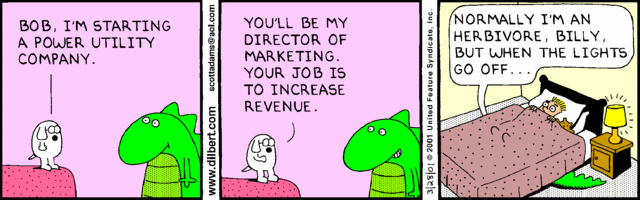
Like most newspaper comics, it far outstayed its welcome and became stale by the early 2000’s, reaching zombie status alongside Garfield, Family Circus, and other dated staples of dying print media. This is likely due to Adams being out of the workforce for over a decade as well as limiting his comic to the corporate environment, casting aside some of the zanier characters like Bob the Dinosaur. He also toned down the silly plots, like when Dogbert tried to raise a cucumber army to conquer the world or his hilariously un-PC book of etiquette. In a grim irony, he corporatized and sanitized his own artistic work for market appeal. He knew how to milk that cow dry, but a redemption arc not even he saw at the time was coming.
The comic revolved around a talented MIT grad named Dilbert employed at a nameless corporation. He lives with a megalomaniacal dog, appropriately named Dogbert, who serves as his opposite. Dilbert is introverted, loves technical challenges, but lacks the confidence and social tact to change his dead-end career trajectory. Dogbert is extroverted, a grand thinker whose only barrier to world domination is not caring enough to follow all the way through. While Dilbert is the personification of a timid mind incapable of willing his reality onto the world. Dogbert is unrestrained ego.
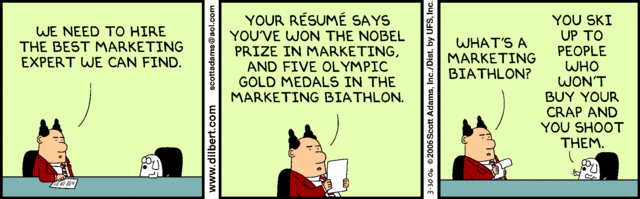
His coworkers range from the hypercompetent but erratic Alice to the slothful Wally. He’s subordinate to the Pointy-Haired Boss, who either dreams up silly tasks or enforces nonsensical dictates from above. It’s a nauseating, labyrinthine hellscape of avoiding responsibility, meaningless chatter, shattered ambitions, incompetent hierarchy, and gratuitous violence. All but the last one is something everyone working in a megacorp has experience with, and the violence and general goofiness fit right in with the surreal world we take for granted.
Everyone has had a version of the pointy-haired boss who memorized the right slogans but was an incompetent fool. Many found resonance in the earlier comics that portrayed the boss as far more vicious, uncaring, and Machiavellian. There was a widening disconnect between the managers and the people they oversaw. This rift has caused all sorts of insanity as the two worlds have split apart. The employees see a plethora of purpose statements, pie-in-the-sky budgetary spreadsheets, nonsense initiatives, and a total lack of order. The managers see employees trying to skirt work, getting caught up in meaningless minutiae, and doing technical tasks they don’t understand anymore. Their ability to communicate has been destroyed.
Sometimes in the face of absurdity the best medicine is to laugh, and “Dilbert” let them do so. Scott Adams had plenty of material from loyal readers eager to tell their stories of stranger-than-fiction memos coming from inside their organization, clueless disrespect, and ignorance of the basic laws of physics. He caught onto a wave everyone was familiar with, especially with the rise of the desk jockey with the computer that allowed an explosion of busywork while making actual verbal communications less necessary.
There’s a less humorous side to this story though. While sometimes laughter is the best medicine, its catharsis will sometimes make someone more at ease with their plight. It feels good to know that there are others who have the same idiotic management styles and touchy-feely wording to mask system decline. It builds rapport with others in various fields to know they are not alone when their budget gets arbitrarily slashed or when the doofus next to them gets promoted. This shared suffering, especially when unavoidable, helps people get through rough patches. Unfortunately, in larger doses it creates a sense of learned helplessness and inability to form agency in one’s own life.
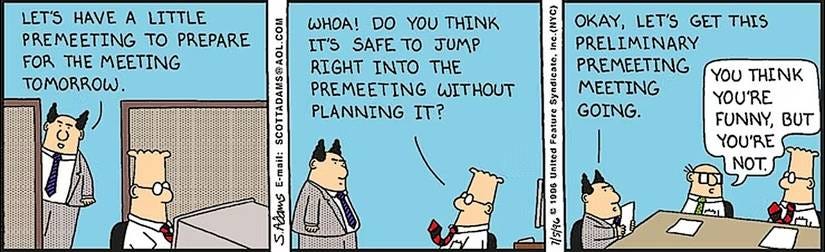
While knowing you are smarter than your boss and grossly underpaid gives a nice ego-boost, you’re still stuck in a dead-end job. Understanding of your situation is the first step in improving your plight, but it’s not an end in itself. As Dilbert became a national phenomenon, countless office drones found a way to laugh, but not a way to escape. If anything, it reinforced the notion that it was the same everyone and such an escape was fantasy.
Dilbert served as the quintessential engineer. He was great at solving objective problems but was paralyzed in his own life. He knew he could do better. He knew the company didn’t deserve him. He knew his talents were being wasted away. Yet he stayed.
Logic would state that those who are most dissatisfied with their work are most likely to leave, yet that’s not how it plays out. Often it’s the guy who doesn’t mind his job but simply wants a new experience who leaves, or the one whose career track is passable but not where he wants to be. Often the loudest complainer, the one with the most emotional scars from being constantly stepped over for promotions and ignored, is the one who plants his feet firmly in the corporation and never leaves.
Sometimes he becomes like Wally, shirking his duties and leeching off the company, but often he will still slave through those brutal 70-hour work weeks to make the deadline, accept a 3% raise every year, and watch as his co-workers leave for better pastures. The same man who dreams of quitting every day will shudder in horror when layoffs are incoming. He takes consolation that he isn’t as clueless as his boss, not as fake as the executives who pretend to like their employees. He says he’s brave enough not to lie to himself, all the while convincing himself he could leave any time. He reads the Dilbert strip every day, relieved he’s not alone. Instead of giving a necessary morale boost in getting through some ugly times, it became his life preserver to justify never improving his plight.
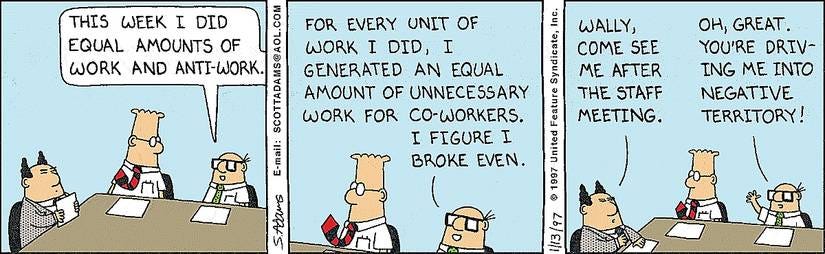
There is a mass of office drones enslaved not through whips, but the shackles of their own minds. Somehow, their calculations always say it’s too risky, that they are bound to fail, so better to stick with the familiar. They have their Dogbert plush toy and the 365-day calendar on their desk, but the cubicle prison still shuts them in, slowly sucking them of their dreams. They need a prophet, a modern-day Moses who can lead them out of their slavery and into freedom.
Scott Adams found his way back into mainstream discourse by being an early Trump analyst. While other pundits were putting on their serious face and balking about threats to democracy, Adams focused on the orange man’s ability to weave a story and engage with his audience’s imagination. Countless people began reading the blog of this old man, a cartoonist of a newspaper daily whose glory days were far behind. It wasn’t just a shot in the dark of a man looking for a new angle, as Adams had been interested in hypnosis his entire life, and saw the same enthralling, attractive energy emanating from a New York real estate mogul. Everyone wondered if “the Dilbert guy” was for real, and Trump’s election solidified him as a visionary.
Previously he had released a book in 2013, a biography of sorts named “How to Fail at Almost Everything and Still Win Big.” While going through his life’s struggles, it read more like a self-help book, telling of the mindset and strategy that could make an average guy fail time and time again and still come out on top. While self-help books are rightfully maligned, this work stood as a truly fresh view of how to live a fulfilling life. He tells of catastrophic failures like the “Dilberito”, a burrito trying to leverage the popularity of his comic into the food industry and failing spectacularly. He talked about how to develop systems instead of goals, take risks but walk away from sunk costs and other advice. Overall, it was the emphasis of action over rumination and risk-taking over a lousy status quo.
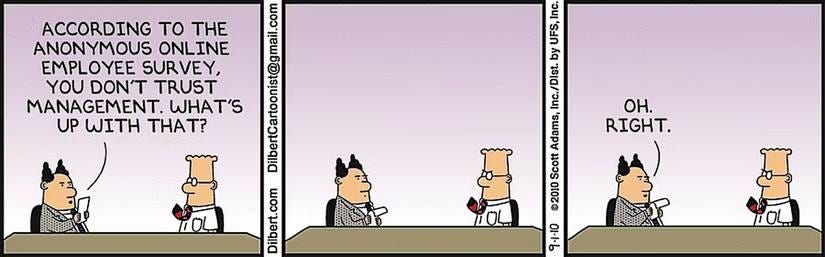
In his later book, “Win Bigly”, he emphasized the near blasphemy of telling grand tales and playing a little loose with the facts as opposed to a factual but ultimately unengaging story. Everything he said went directly against the average person who read his comic, a technically proficient, facts focused, and deeply analytical mind. In “Loserthink” he goes into the mental habits of the Dilberts of the world and how they impede their own happiness. In the end, he essentially encouraged people to accept some methods of those in the corporate ladder he mercilessly lampooned in his comic. When one listens to his countless videos and written articles, you don’t see a nerdy guy advocating being a nerdy guy. You see a man who wants you to be the anti-Dilbert.
Of course, his emphasis on grand ideas, psychological tricks, and playing easy with minutiae made him a lousy philosopher, and those who took his ideas to the extreme would find themselves inside a chasm of nihilism. His last act, a conversion to Christianity straight out of Pascal’s Wager, shows a personality far too obsessed with being clever. He knew what he was doing though. He knew that his readers didn’t need a grand philosophical theory they could study for decades while doing nothing in their own lives, but a powerful testament that would take a battering ram to their psychological walls, leaving nothing but waste of their mental barriers. They didn’t need more mental masturbation. They needed a jarring slap in the face.
When Dilbert got cancelled in 2023 after Scott Adams showed his power level, he didn’t seem to care. He started Dilbert Reborn for a while, but it petered off quickly. It was clear he was tired of the comic and likely grew sick of writing it a long time ago. It was also the most poetic way to go out too. After years of laughing at a suffocating corporate hell and his own comic turning into shackles, Dilbert’s creator had enough. He pulled a Leeroy Jenkins and set himself free, even if it meant destroying the catalyst for his success.
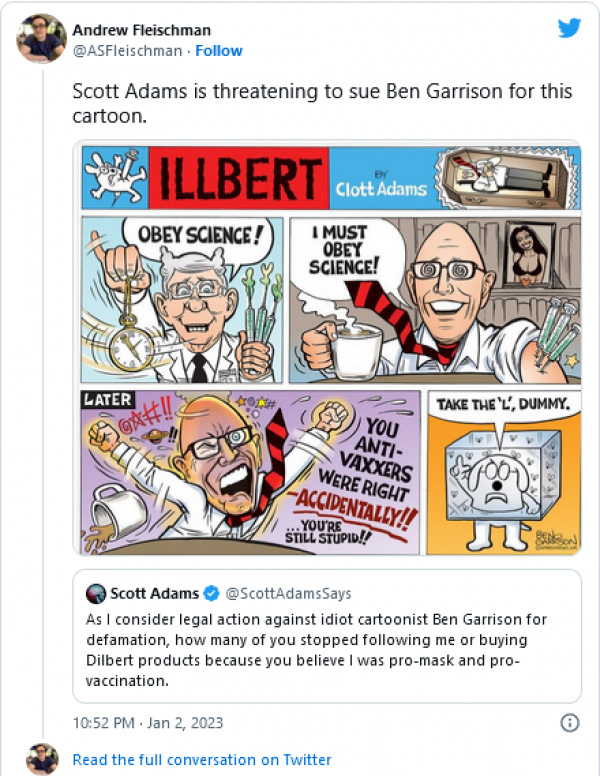
He had already found new success and had plenty of f*ck you money to not worry about cancellation. Of course, he failed plenty also. He slipped in the Covid debacle and quasi-advocated for the vaccine, trying to be too clever for his own good. Even after trying to sue Ben Garrison for one of the most brutal political smackdowns ever drawn, he recovered. He failed and got back up, just like he did his entire life. He became an arch-enemy of polite company in the woke era, a lolcow of dissident discourse, and made some questionable decisions in his personal life, yet he persevered, laughing all the way.
It remains to be seen what Scott Adams’ legacy will be. Dilbert is unlikely to become a beloved icon of the newspaper comic era like “Calvin and Hobbes” or “The Far Side”, but everyone can agree it scratched an itch that needed scratching. I see his nonfiction having longevity, written in a fun, brisk style that truly challenged his readers to get out of stifling and counterproductive thought patterns, especially in their careers.
It would have been easy to take the Jim Davis “Garfield” route by playing it safe and soaking in the licensing revenues as a has-been comic. Yet all his tinkering in seemingly unrelated fields of hypnosis, psychology, and neuroscience gave him insights that led him to new pursuits. None of his life was planned, but it’s rare to see such a character arc developed like it was written for a screenplay.
It’s the story of the office nobody who fell into fame and fortune through his storytelling, fell down and got back up over and over again, and at the end of his life helped his loyal fans to escape the doom and drudgery of the world he lampooned with a smile and wink. He killed Dilbert, and beckoned us to do the same.
Rest in Peace Scott, you were truly one-of-a-kind.
Calvin vs. Susie

My boys love Calvin and Hobbes, and throughout the day the household is inundated with dialogue lifted from the pages of the complete collection they ravenously read. As a dad who has warm memories of childhood reading these comic collections, seeing such a treasure being passed down fills my heart.
Thank you for reading Social Matter. If you enjoyed this article, please share and subscribe. If you are a pointy-haired boss, please become a paid subscriber.
I read The Dilbert Future when I was in early high school or something. I had never been in an office but loved the book. I still remember the bit about Star Trek.
One big change from the Dilbert era is Work From Home. WFH makes a lot of Dilbert type jobs tolerable, even a good deal. Spending 40 hours in a cubicle and commuting is terrible. Spending a couple hours on zoom calls you aren't paying attention to while doing chores or picking up your kid as a breeze.
Scott Adams was one of the more interesting people of the 10's and 20's. He put himself out there, did some dumb stuff, had some good ideas. Win Bigly and HTFAEASS are quality books. He's a good example of having a great life. I never watched his podcast but always enjoyed whenever I saw a clip of him or his good Tweets.